projects
Infra-Maxxer
Treating GPU compute as something you can hedge, not just a bill you brace for.
View the live siteEvery AI company obsesses over token spend. Almost nobody thinks about the price of the metal those tokens run on, and that price swings hard. Infra-Maxxer pulls a live forward curve for GPU compute, compares it against your real usage and cost signals, and tells you when to lock, when to wait, and how much capacity to reserve. Token-maxxing was the warm-up. Infra-maxxing is the game.
Treasury desks don't accept whatever interest rates or exchange rates land on billing day. They read a forward curve, see where prices are heading, and lock in the good ones early. Rates, FX, oil, electricity — all of it has a forward market so a bad month doesn't blow up the budget. Compute is the one giant, volatile cost that never got that treatment, so the reserve-versus-on-demand call gets made against today's price and today's availability, never against a forecast. It's deciding whether to lock a mortgage rate while ignoring the rate forecast.
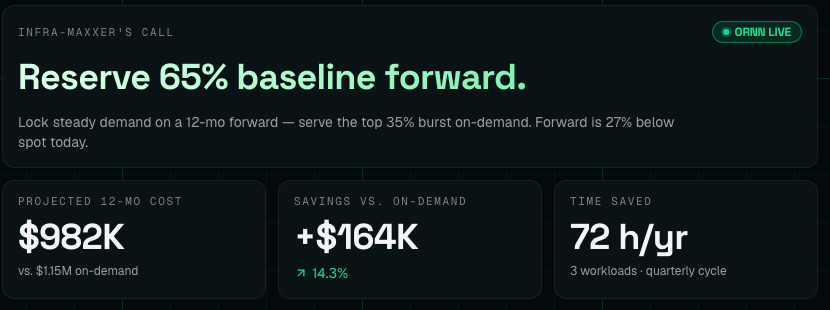
A forward curve is the market's best guess at future prices — a weather forecast for GPU-hours. Feed it, plus your own usage forecast, into the reserve decision and that decision finally has the input it was missing. Forecast rising against a steady base load: reserve now. Forecast falling: stay flexible and commit shorter. Bursty and uncertain: reserve the stable floor and let the peaks overflow on-demand. Every call ships with a projected saving and a confidence band, because the forecast can be wrong and a person still makes the decision. It also respects what every infra team already knows — reservations are capacity insurance first. Infra-Maxxer doesn't fight the instinct to reserve; it adds the price-timing lens that instinct never had.
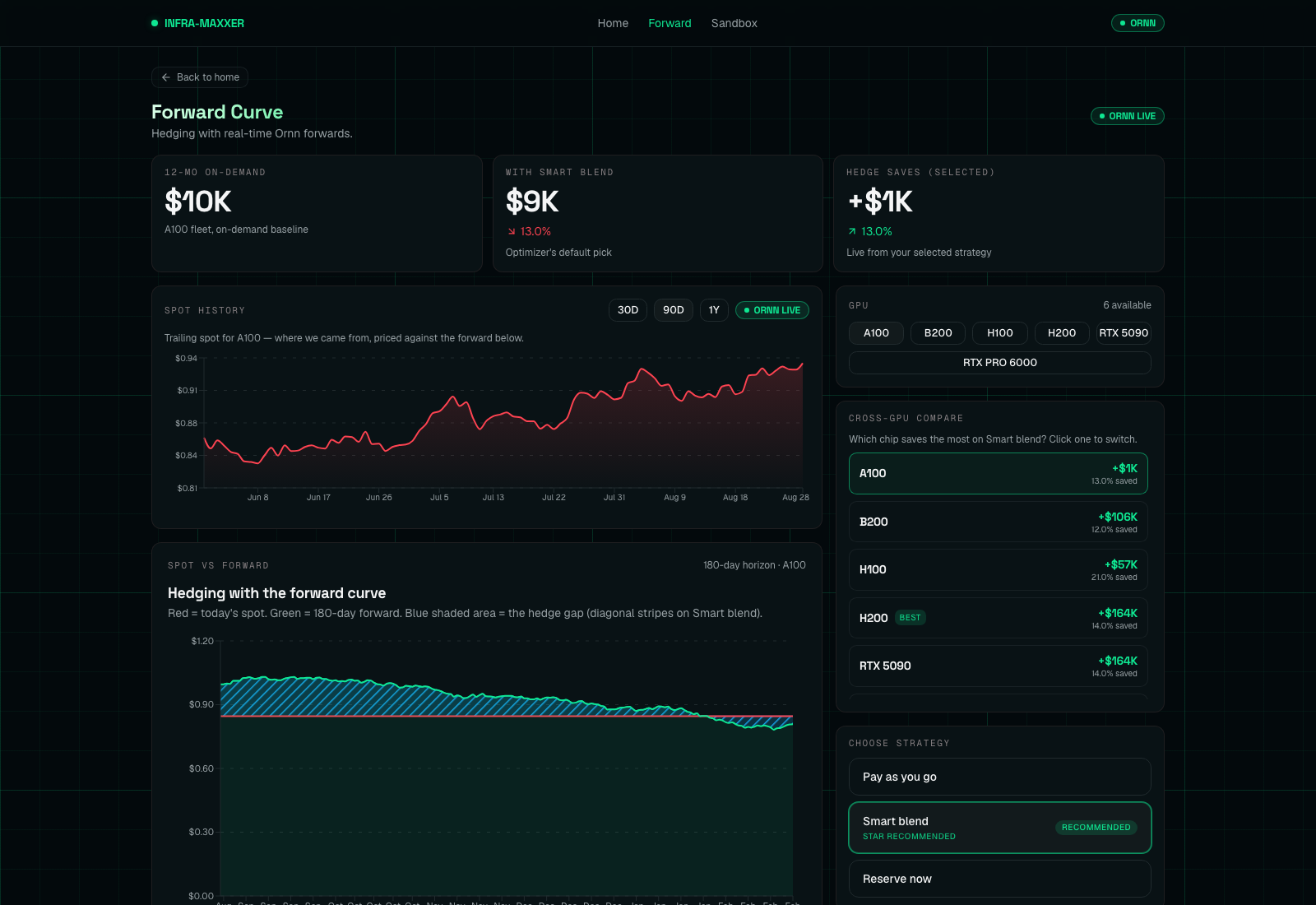
Built at Ramp Builders Cup X, where it reached the final round of the Save Time, Save Money track. Next.js 16 on the App Router, with React 19, TypeScript, Tailwind v4, shadcn/ui on Base UI, Recharts for the curve and spot-history plots, Supabase, and Vercel. Server routes pull live Ornn forward-curve quotes, trailing spot history, and chip coverage across A100, B200, H100, H200, RTX 5090, and RTX PRO 6000, join them against fleet usage and workload telemetry from Datadog, then run the backtest, recommendation, and portfolio passes. The sandbox re-runs the optimizer end-to-end on every input change: expected workload growth, share of the baseline reserved, a horizon from three months to three years, and a market-stress scenario that swaps in a bear curve.